
 en
en


A budget Inca Trail tour is possible, but finding the lowest price should not be your only goal. The Inca Trail is a regulated route to Machu Picchu. Permits, guides, transportation, support staff, meals, and trail logistics are all part of the experience and affect the final price.
The smarter way to save is to choose a shared group tour, avoid upgrades you do not need, understand exactly what your package includes, and plan early. This guide explains the expected costs, possible hidden expenses, 2-day versus 4-day options, and how to plan an affordable Inca Trail 2027 adventure without cutting the services that really matter.
A budget Inca Trail tour is possible, but finding the lowest price should not be your only goal. The Inca Trail is a regulated route to Machu Picchu. Permits, guides, transportation, support staff, meals, and trail logistics are all part of the experience and affect the final price.
The smarter way to save is to choose a shared group tour, avoid upgrades you do not need, understand exactly what your package includes, and plan early. This guide explains the expected costs, possible hidden expenses, 2-day versus 4-day options, and how to plan an affordable Inca Trail 2027 adventure without cutting the services that really matter.
How Much Does a Budget Inca Trail Tour Cost?
There is no single fixed price for an Inca Trail tour.
The Peruvian government controls access to the trail, but individual tour companies decide their package prices based on factors such as:
- Group size
- Number of guides
- Porter services
- Camping equipment
- Meals
- Transportation
- Train service
- Equipment rental
- Extra services
As a general planning range, budget-focused Classic Inca Trail tours can start in the mid-$500s and rise depending on what is included.
Champions Peru Travel's current Inca Trail cost guide uses around $550 to $690 as a reference range for budget trips and approximately $600 to $950 for standard Classic 4-day options.
However, these should be treated as planning ranges rather than fixed government prices.
Instead of asking only:
“How much does the tour cost?”
Ask:
“How much will the whole trip cost after everything I need is included?”
That question can help you avoid choosing a tour that looks cheap at first but becomes expensive after extra charges are added.
Why Is the Inca Trail More Expensive Than a Normal Hike?
The Inca Trail is not an unrestricted hiking route.
Peru controls access to the Red de Caminos Inka to protect its archaeological sites, natural environment, and cultural heritage.
Daily access is limited. Current regulations allow up to:
- 500 users per day on Routes 1 to 4
- 250 users per day on Route 5
- 100 users per day on Route 6
These numbers include tourists as well as guides, porters, and other people working on the trail.
Visitors arriving at Machu Picchu through the Inca Trail must also follow specific entrance and permit rules.
This is why you cannot save money in the same way you could on an unrestricted backpacking trail.
A proper Inca Trail tour requires organized access, guiding, transportation, and support.
What Should Be Included in a Budget Inca Trail Tour?
Never compare two Inca Trail tours based only on their advertised prices.
First, check exactly what each package includes.
A $550 tour may not actually be cheaper than a $650 tour if several important services have to be purchased separately.
Inca Trail Permit and Machu Picchu Access
Your operator should clearly explain which Inca Trail permit and Machu Picchu entrance are included.
Ask about this before paying your deposit.
Do not assume every package advertised as an “Inca Trail tour” includes exactly the same tickets or entrance arrangements.
The permits required to enter the official trail are an essential part of the trip and should not be treated as an optional upgrade.
Professional Guide
A guide is much more than someone who shows you which direction to walk.
Your guide helps:
- Manage the group's pace
- Explain archaeological sites
- Coordinate with porters and support staff
- Organize camps
- Help with changing conditions
- Keep the trekking group organized
When comparing budget tours, also ask about the maximum group size.
A low-priced tour with a very large group may feel different from a slightly more expensive trip with fewer hikers.
Porters, Meals, and Camping Equipment
On the Classic 4-day Inca Trail, porters carry group equipment, food, tents, and other supplies.
This is one area where you should be cautious about extremely low prices.
Peruvian labor rules protect Inca Trail porters. Maximum porter loads are regulated, with limits of 20 kg for men and 15 kg for women.
Saving a small amount of money should never depend on poor working conditions for the people supporting your trek.
Before booking, ask:
- How much personal porter allowance is included?
- Who carries group tents?
- Who carries cooking equipment?
- Which meals are provided?
- Is drinking water supplied?
- What type of sleeping mat is provided?
- Are vegetarian or other dietary options available?
A good budget tour reduces unnecessary luxury. It should not reduce responsible treatment of staff.
Transportation and Return Train
Transportation can make a big difference to the final cost.
Check whether your package includes transportation from Cusco to the starting point of the trail.
You should also confirm what happens after Machu Picchu.
Ask whether the price includes:
- Transportation to the trailhead
- Bus transportation where required
- Return train
- Transportation from the train station back to Cusco
- Hotel drop-off
Instead of comparing only the hiking portion, compare the complete journey from your hotel in Cusco until you return.
What Costs Are Often Not Included?
Even a good Inca Trail package may leave some personal expenses outside the advertised price.
Knowing about them before you book makes budgeting much easier.
Sleeping Bags and Trekking Poles
Sleeping bags and trekking poles may be available for an additional rental fee.
If you already own suitable trekking equipment, bringing your own can save money.
However, do not buy hundreds of dollars of new equipment just to avoid a smaller rental charge.
Compare the cost of buying, transporting, and renting before deciding.
Tips
Tips for guides, cooks, and porters are normally separate from the main tour price.
A tip is not the same as a government fee.
Ask your tour operator what is normally expected so you can include it in your travel budget.
Hotels Before and After the Trek
Many trekking packages include pickup from your Cusco accommodation but do not include the hotel itself.
You should also avoid trying to save money by arriving in Cusco immediately before beginning a high-altitude trek.
Cusco sits at around 3,350 meters, or approximately 11,000 feet, above sea level.
Spending some time adjusting to the altitude before beginning a demanding trek can make your trip more comfortable.
Include those extra nights when calculating your complete Peru budget.
Travel Insurance and Personal Expenses
Travel insurance is generally separate from the trekking package.
You may also spend money on:
- Snacks
- Drinks
- Souvenirs
- Laundry
- Extra equipment
- Personal medicines
- Additional activities
- Hotels
- Airport transportation
Setting a personal spending budget before your trip can help keep these smaller expenses under control.
4-Day vs 2-Day Inca Trail: Which Is Better for a Budget?
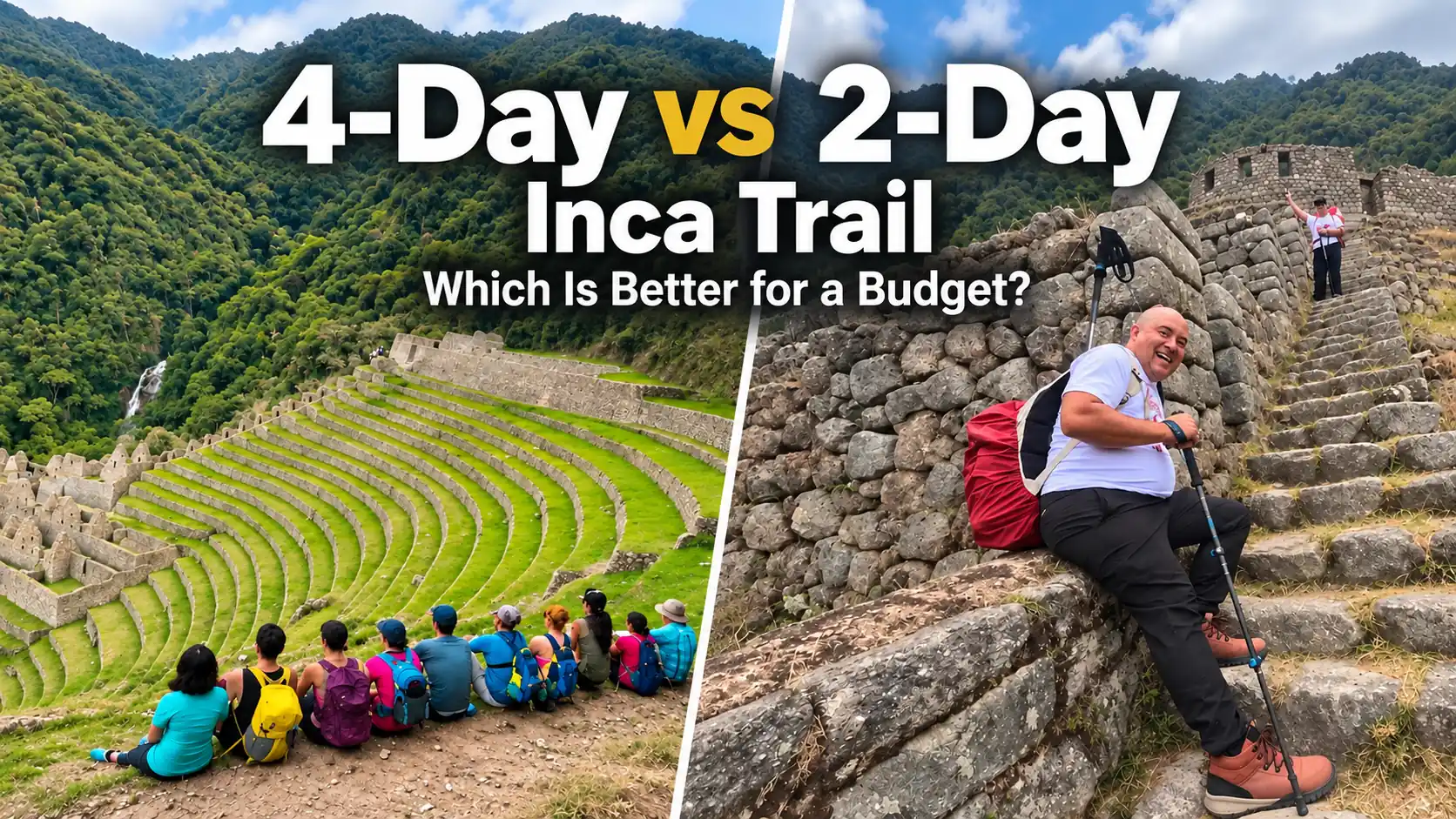
The 2-day Inca Trail can cost less than the Classic 4-day route, but it is not simply half the cost.
Many important expenses remain even though you are trekking for fewer days.
You still need controlled trail access, professional guiding, transportation, and Machu Picchu arrangements.
Classic 4-Day Inca Trail
The 4-Day Classic Inca Trail is ideal for travelers who want the complete trekking and camping experience.
The route covers roughly 43 kilometers and reaches its highest point at Dead Woman's Pass, which sits about 4,215 meters above sea level.
The experience normally includes several days of hiking through mountain scenery, archaeological sites, cloud forest, and ancient Inca pathways before reaching Machu Picchu.
The total price is higher than a shorter trek, but the cost per trekking day can represent better value for travelers whose main goal is experiencing the full Inca Trail.
Short 2-Day Inca Trail
The 2-Day Short Inca Trail may be a better choice if you have limited time or do not want several nights of camping.
It still allows travelers to hike part of the historic Inca Trail and approach Machu Picchu through the famous Sun Gate.
Because the shorter route still requires permits, trains, guides, and Machu Picchu arrangements, its price is not simply half that of the 4-day trek.
Which One Should You Choose?
Choose based on the experience you want rather than the number of days alone.
If walking the full historic route is one of the main reasons you are visiting Peru, choosing the shorter route only to save money may leave you disappointed.
However, if your main goal is to experience part of the Inca Trail and visit Machu Picchu without doing a multi-day camping trek, the 2-day option can be a smart choice.
How to Save Money on a Budget Inca Trail Tour
You can reduce the cost of an Inca Trail trip without reducing the quality of the core experience.
Here are some of the most practical ways.
Join a Group Departure
Private Inca Trail tours normally cost more because fewer people are sharing the guide, transportation, and other operating expenses.
Joining a scheduled group departure is one of the easiest ways to reduce your cost.
You still receive professional guiding and organized support, but some expenses are shared among more travelers.
Skip Luxury Upgrades
Ask yourself which upgrades will actually improve your experience.
Budget travelers often do not need:
- Luxury train upgrades
- Private tents
- Premium mattresses
- Private guides
- Luxury hotel upgrades
- Additional mountain tickets
- Premium transportation
Spend money on the things that affect your main trekking experience first.
Add upgrades only if they genuinely matter to you.
Bring Equipment You Already Own
Already have good trekking poles?
Bring them.
Already own a suitable sleeping bag?
You may be able to use it instead of renting one.
However, calculate airline baggage costs too.
Sometimes renting a sleeping bag or poles in Peru can be cheaper than paying to transport bulky equipment internationally.
Compare Final Prices Instead of Starting Prices
This is one of the most important things you can do.
Imagine Tour A costs $575 and Tour B costs $675.
Tour A looks cheaper immediately.
But then you discover that Tour A charges separately for:
- Sleeping bag rental
- Trekking poles
- Personal porter allowance
- Some transportation
- Additional tickets
Tour B already includes most of those items.
The final difference may become very small.
The lowest advertised price is not always the lowest-cost trip.
Planning a Budget Inca Trail Tour for 2027
If you are planning the Inca Trail 2027, it is better to start researching your preferred dates early.
The official Inca Trail has limited daily capacity.
That means waiting until the last minute can reduce your choices.
You may lose access to:
- Your preferred departure date
- Lower-cost group departures
- Your preferred operator
- Convenient train options
- Hotels within your preferred budget
Champions Peru Travel is currently accepting reservations for its 2027 Inca Trail trips.
However, travelers should understand the difference between making an advance reservation with a tour operator and the official government permit-sale process.
At the time of writing, the official government opening date for the 2027 Camino Inka permit sales should still be confirmed through the relevant Peruvian authorities.
For comparison, official sales for the 2026 season began in November 2025.
If you are planning for 2027, ask your operator two separate questions:
- Can I reserve my preferred 2027 departure date now?
- When will my official government permit be purchased and confirmed?
This avoids confusion.
Can You Save Money by Traveling in the Shoulder Season?
Many travelers focus on June, July, and August because these months fall within Peru's drier trekking season.
However, months around the main peak season may also be worth considering.
April, May, September, and October can provide a balance between weather conditions and demand.
Weather in the Andes can change quickly at any time of year, so there is never a guarantee of completely dry conditions.
Planning outside the busiest dates may also give you more flexibility when looking for affordable group departures.
Do Not Plan the Official Inca Trail for February
February is different.
The official Inca Trail normally closes during February for annual maintenance and conservation work.
That means February is not simply a quieter or cheaper month for the Classic Inca Trail.
You cannot book the regular Classic Inca Trail while the route is officially closed.
If your Peru trip must happen in February, consider visiting Machu Picchu using another route or transportation option instead.
Where You Should Not Try to Save Money
There is an important difference between an affordable tour and a poorly organized one.
Do not choose an operator simply because its number is lower than everyone else's.
Be cautious if the company cannot clearly explain:
- Which permit you receive
- Which Machu Picchu entrance is included
- Its authorization to operate the trail
- Group size
- Guide arrangements
- Porter conditions
- Meals
- Camping equipment
- Transportation
- Emergency procedures
- Cancellation rules
- Refund policies
Budget travel should mean removing things you do not need.
It should not mean removing the services needed to run the trek properly.
Budget Inca Trail Tour Checklist Before You Pay
Use this checklist when comparing operators.
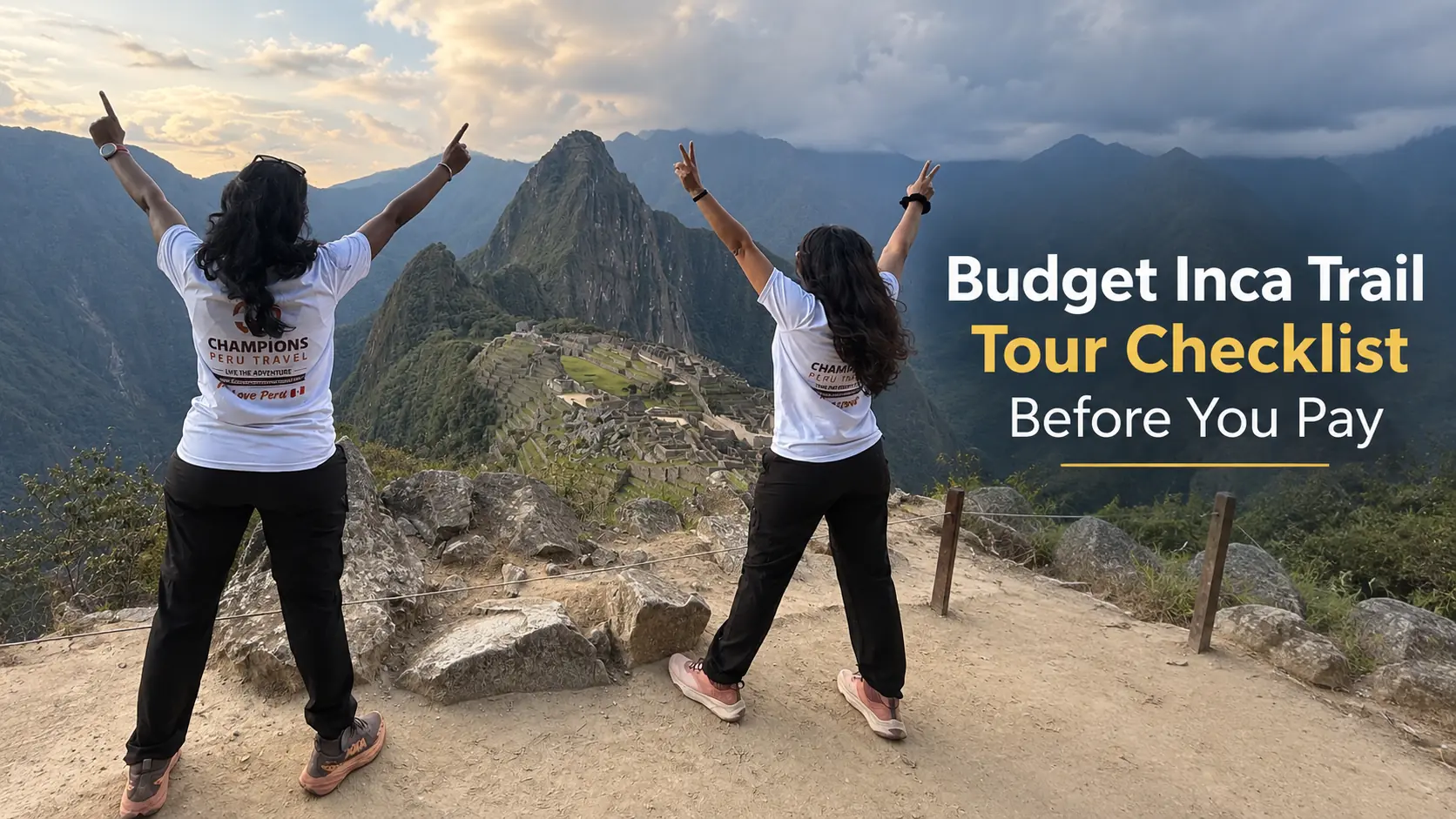
Before paying your deposit, ask:
- Which Inca Trail route am I booking?
- What is the full price per person?
- Is the official Inca Trail permit included?
- Is Machu Picchu admission included?
- What is the maximum group size?
- How many guides will accompany the group?
- Which meals are included?
- What camping equipment is provided?
- How much personal porter allowance is included?
- Is the sleeping bag included or rented separately?
- Are trekking poles included?
- Which return train service is included?
- Is transportation back to Cusco included?
- Are there any additional required fees?
- What are the cancellation conditions?
- What happens if the government temporarily closes the trail?
- When will my official permit be confirmed?
You can also review the Inca Trail permit and availability guide while planning your dates.
Why Travel With Champions Peru Travel?
Planning a Machu Picchu trip involves much more than choosing a travel date. Entrance tickets, circuits, trains, transportation, accommodation, guides, and other parts of your itinerary all need to work together.
Traveling with Champions Peru Travel gives you the support of a local team that understands the practical details involved in organizing a Machu Picchu journey.
Local Experts Based in Cusco
Champions Peru Travel is based in Cusco, giving our team local knowledge of Machu Picchu, the Sacred Valley, regional transportation, travel conditions, and the logistics involved in planning your visit.
Help With Machu Picchu Tickets
Machu Picchu entrance tickets are limited by date, circuit, route, and entrance time.
When you book with Champions Peru Travel, our team can help prepare your reservation details in advance and organize the required Machu Picchu entrance according to official availability.
This is especially useful for travelers planning ahead for 2027, when popular dates and circuits may become limited soon after tickets are released.
Personalized Travel Planning
Every traveler has different priorities.
Some visitors want the classic Machu Picchu experience, while others may prefer panoramic viewpoints, an additional mountain hike, the Sacred Valley, or more time exploring the Cusco region.
Our team can help organize your itinerary according to your available time, travel style, preferred activities, and overall Peru travel plans.
Experienced Local Guides
Visiting Machu Picchu with a knowledgeable local guide can make the experience much more meaningful.
Our guides help travelers understand the history, architecture, archaeological areas, Inca culture, and landscapes surrounding Machu Picchu while also helping them follow the route included with their entrance ticket.
Coordinated Travel Logistics
A successful Machu Picchu trip depends on several reservations working together.
Champions Peru Travel can help coordinate your Machu Picchu entrance, transportation, trains, accommodation, transfers, and guiding services so that each part of your itinerary fits together properly.
Support Before and During Your Trip
Our team can also help with questions about tickets, transportation, altitude, packing, accommodation, circuits, and general trip preparation before you arrive in Peru.
With local support throughout the planning process, you can spend less time worrying about logistics and more time enjoying your Machu Picchu experience.
Think About Your Total Peru Trip Budget
The trek itself is only part of your travel spending.
American travelers should also consider:
- International flights
- Domestic flights
- Cusco accommodation
- Meals before and after the trek
- Travel insurance
- Airport transfers
- Equipment
- Extra tours
- Souvenirs
- Tips
- Emergency spending
Setting a complete trip budget before booking the trek makes it much easier to know how much you can comfortably spend on the Inca Trail itself.
For example, paying an additional amount for a better-organized trekking package may be more useful than spending the same amount upgrading your Cusco hotel.
Think about which experiences matter most to you.
Is a Budget Inca Trail Tour Worth It?
Yes, as long as “budget” means paying for the main experience while skipping extras that do not matter to you.
You do not need luxury camping to enjoy the Inca Trail.
You do not need the most expensive train seat.
You do not necessarily need private guiding.
You may not need premium equipment.
But permits, responsible staffing, reliable transportation, proper camping equipment, and professional organization are different.
Those are part of what makes the trek work.
A good budget Inca Trail tour should give you a simpler version of the complete experience rather than a poorly supported version of it.
Plan Your Budget Inca Trail Tour Carefully
The best budget Inca Trail tour is not necessarily the tour with the smallest price written on the website.
Look at the complete package.
Join a group if you do not need private service. Skip luxury upgrades. Bring equipment you already own when it makes financial sense. Check what your permit, train, porter service, equipment, and transportation include.
And if you are planning an Inca Trail 2027 trip, start checking your preferred dates early.
The goal is not to find the cheapest possible Inca Trail.
The goal is to spend your money on the parts of the experience that really matter.
If you are comparing dates or deciding between the 2-day and 4-day routes, you can contact Champions Peru Travel for current availability and package details.
Phone: +51 986 029 262
Email: info@championsperutravel.com
Frequently Asked Questions About Budget Inca Trail Tours
What is the cheapest way to hike the Inca Trail?
Joining a shared group departure with a licensed operator is generally one of the most affordable ways to hike the official Inca Trail. Choosing standard transportation, avoiding luxury upgrades, and bringing suitable equipment you already own can reduce the total cost further.
Can I hike the Inca Trail without a tour company to save money?
The official Inca Trail is controlled through a permit and authorized operator system. It is not the same as an unrestricted hiking trail where you can simply arrive and hike independently.
Is the 2-day Inca Trail cheaper than the 4-day Inca Trail?
Usually, but not by half. The 2-day route still involves permits, guides, trains, transportation, and Machu Picchu access, so many fixed costs remain.
Are Inca Trail permits included in the tour price?
Many established operators include them, but you should never assume this. Ask the company to clearly explain which permit and entrance tickets are included before paying.
Is February cheaper for hiking the Inca Trail?
No. The official Inca Trail normally closes during February for conservation and maintenance work. Travelers visiting Peru during February need to consider other routes or ways of reaching Machu Picchu.
How early should I book the Inca Trail for 2027?
Start planning as early as possible if you have fixed dates, especially for popular travel months. Official daily capacity is limited, and availability can decrease as your preferred departure gets closer.
Should I choose the cheapest Inca Trail company?
Not automatically. Compare permits, guiding, porter services, equipment, meals, transportation, group size, and other inclusions before comparing the final price.
Are porters included in budget Inca Trail tours?
Porter arrangements vary between packages. Group equipment is generally handled by trekking crews, but the amount of personal luggage a porter carries for you may vary. Ask exactly what personal porter allowance is included.
Do I need to stay in Cusco before the trek?
Spending time in the region before beginning a high-altitude trek is generally a sensible part of trip planning. Cusco is located at approximately 3,350 meters above sea level, so arriving immediately before a demanding hike is not ideal for many travelers.
What hidden costs should I check before booking?
Common extras may include sleeping bag rental, trekking poles, extra porter services, tips, hotels, travel insurance, personal expenses, and optional upgrades.