
 en
en


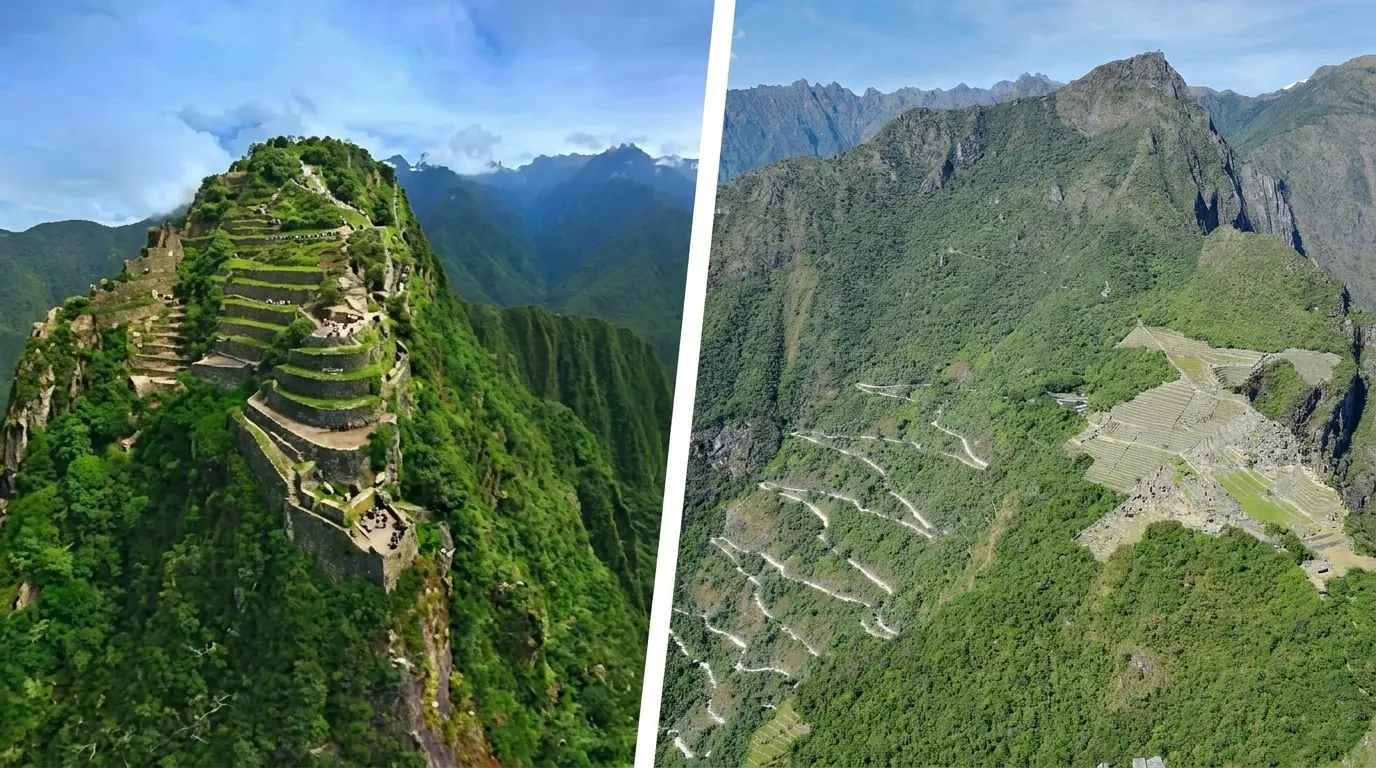
Visiting Machu Picchu is a once‑in‑a‑lifetime experience. Most travelers are satisfied just exploring the archaeological city, but adventurous visitors can also add a climb to Huayna Picchu or to Montaña Machu Picchu. Both mountains flank the stone citadel and offer different perspectives of Peru’s most famous UNESCO World Heritage Site, which sits about 2,430 m (7,970 ft) above sea level.
Because permits are limited and the terrain can be challenging, it’s important to choose the trail that suits your goals, physical condition, and travel style. This extensive guide compares the two hikes, discusses logistics, and provides practical tips tailored for travelers from the United States who dream of experiencing the Andes.
Understanding Machu Picchu and Its Mountains
Machu Picchu was built during the reign of Inca Emperor Pachacuti in the 15th century. The royal citadel remained hidden during the Spanish conquest and was largely unknown to the outside world until the American historian Hiram Bingham publicized its existence in 1911. The name “Machu Picchu” comes from the Quechua phrase machu pikchu, meaning “old mountain”.
Today, the ruins are perched on a saddle between two peaks: Huayna Picchu (also spelled Wayna Picchu), which rises behind the classic postcard image, and Machu Picchu Mountain (also called Montaña Machu Picchu or the “Old Mountain”), which towers above the citadel and shares the same name. The town of Aguas Calientes, located 6,690 ft (2,040 m) above sea level, serves as the gateway to the site.
Why the Hikes Are Special
Both mountains offer panoramic views of the citadel and the surrounding cloud forest. Huayna Picchu is popular for its steep stone staircases, narrow pathways, and proximity to Inca structures, including the Temple of the Moon and terraced gardens.
Machu Picchu Mountain, on the other hand, has broader, less‑steep paths and provides sweeping vistas of the citadel and the rugged Andes.
The highest point of Montaña Machu Picchu reaches 3,082 m (10,111 ft), while Huayna Picchu peaks at about 2,693 m (8,835 ft). Both climbs require separate permits in addition to general entry tickets, and daily quotas mean that travelers must plan.
Huayna Picchu - The Iconic Pinnacle
Location and Altitude
Huayna Picchu stands immediately north of the Machu Picchu ruins. Its dramatic peak rises approximately 2,693 m (8,835 ft) above sea level, about 400 m higher than the citadel itself.
The trail starts near the citadel’s Sacred Rock and ascends through dense vegetation and Incan stairways carved into the granite. Although it’s not the highest mountain in the area, its sheer slopes and proximity to the ruins make it visually striking and widely recognizable.
Trail Description and Difficulty
The Huayna Picchu hike is a moderate to challenging trek that takes 2–3 hours round trip. The climb is steep, with narrow staircases known as the “Stairs of Death” and sections where metal cables help hikers navigate exposed cliffs.
At one point, the trail passes through a small cave and emerges onto terraces that overlook the entire sanctuary. Because of its challenging terrain, this hike is not recommended for travelers with vertigo, severe knee problems, or mobility issues. Younger children and those uncomfortable with heights should avoid it.
Key statistics for Huayna Picchu:
| Attribute | Details |
| Elevation gain | ~1,469 ft (447 m) |
| Distance | About 3.1 mi (5 km) round trip |
| Estimated time | 2–3 hours |
| Slope | Around 60° |
| Ticket availability | 200 permits per day in four entry slots (7 a.m., 8 a.m., 9 a.m., and 10 a.m.) |
| Best season | Dry season (April–October) when trails are drier |
Highlights of the Huayna Picchu Hike
- Adrenaline‑pumping ascent – Expect steep staircases, cliffside paths, and cable‑assisted sections.
- Archaeological ruins – See the Temple of the Moon and Inca terraces carved into the mountain.
- Unique perspective of Inti Punku – The summit offers a distinctive view of the Sun Gate (Inti Punku) and the surrounding Urubamba Valley.
- Great Cavern – A natural cave along the route provides shade and a chance to explore a hidden Inca chamber.
- Limited permits – With only about 200 visitors per day across four time slots, the hike feels exclusive. Tickets often sell out months in advance, so early booking is essential. Travel agencies like Champions Peru Travel can assist with securing permits.
Who Should Hike Huayna Picchu?
Huayna Picchu is ideal for physically fit travelers who want a short yet intense adventure. If you crave adrenaline, are comfortable with heights, and enjoy exploring Incan structures, this hike offers a memorable challenge.
Photographers will love the dramatic angle of the classic postcard view, and the limited number of permits adds a feeling of exclusivity. However, if you have knee issues, suffer from vertigo, or are traveling with young children or older family members, you may be more comfortable on Machu Picchu Mountain.
Machu Picchu Mountain - The Panoramic Giant
Location and Altitude
Montaña Machu Picchu rises to the highest point in the sanctuary at about 3,082 m (10,111 ft). Located on the southwestern side of the citadel, it is sometimes confused with the citadel itself because they share the name “Machu Picchu.”
The summit is about 400 m higher than the ruins. From this elevated perspective, hikers are rewarded with sweeping 360‑degree views of the Andes, the Urubamba River, and the distant peaks of the Vilcabamba mountain range.
Trail Description and Difficulty
The trail to Machu Picchu Mountain is longer but less steep than the Huayna Picchu route. The round‑trip distance is about 3.8 km (2.4 mi), with an elevation gain of 1,801 ft (548 m). Hikers typically take 3–4 hours to complete the climb. The path is wider and more stable, making it safer for those uncomfortable with narrow ledges.
Much of the route is lined with lush cloud‑forest vegetation and stone terraces. The hike is considered moderate to challenging because of the altitude and the continuous uphill trek, but it’s not as vertigo‑inducing as its counterpart.
Key statistics for Machu Picchu Mountain:
| Attribute | Details |
| Elevation gain | ~1,801 ft (548 m) |
| Distance | About 2.4 mi (3.8 km) round trip |
| Estimated time | 3–3.5 hours (some sources say 3–4 hours) |
| Slope | Around 30° |
| Ticket availability | Up to 300 visitors per day with two entry times (7 a.m. and 9 a.m.) |
| Best season | Dry season (April–October) for clearer skies |
Highlights of the Machu Picchu Mountain Hike
- Panoramic vistas – From the summit, you can enjoy 360‑degree views of the sanctuary and surrounding mountains. The panorama includes the Urubamba River, the Vilcabamba range and the entire archaeological city from above.
- Biodiversity – The trail passes through a cloud forest filled with orchids, bromeliads, and hummingbirds. Lucky hikers might spot the endangered spectacled bear.
- Tranquility – Fewer visitors hike this mountain, so the summit is generally quieter than Huayna Picchu. The spacious summit allows room to rest and absorb the scenery.
- Cultural significance – Scholars believe the mountain had defensive, astronomical, and spiritual functions. Its sacred status adds depth to the hike.
- Accessible for varied fitness levels – The path is wider and less exposed, making it suitable for families, older adults, and those uneasy with heights. You still need a good fitness level due to the altitude and length, but the climb feels less intimidating.
Who Should Hike Machu Picchu Mountain?
If you’re traveling with family members, prefer a gradual climb, or simply want to avoid steep drop‑offs, Machu Picchu Mountain is a rewarding choice. It’s perfect for travelers looking for expansive panoramas and a quieter environment.
Photographers appreciate the large summit area for setting up tripods and capturing unobstructed vistas. Those prone to vertigo will find this hike more comfortable than Huayna Picchu because the trail is wider and less exposed.
Comparing Huayna Picchu and Machu Picchu Mountain
To decide which hike fits your travel style, consider the differences in elevation, difficulty, duration, permits, and overall experience. The table below summarizes key distinctions:
| Feature | Huayna Picchu | Machu Picchu Mountain |
| Location | North of the citadel | South‑west of the citadel |
| Altitude | ~8,835 ft (2,693 m) | ~10,111 ft (3,082 m) |
| Elevation gain | ~447 m | ~548 m |
| Distance | ~5 km (3.1 mi) | ~3.8 km (2.4 mi) |
| Slope | Steep (~60°) | More gradual (~30°) |
| Trail width | Narrow with exposed edges and metal cables | Wider, more stable paths |
| Duration | 2–3 hours round trip | 3–4 hours round trip |
| Ticket quota | 200 permits per day in 4 time slots | 300 permits per day in 2 time slots |
| Highlights | Temple of the Moon, narrow staircases, classic postcard view | 360‑degree panoramas, biodiversity, and spacious summit |
| Ideal for | Adventure seekers, thrill‑lovers, experienced hikers | Families, photographers, and those seeking panoramic views |
| Not suitable for | Individuals with vertigo or knee problems | Travelers with limited time or who prefer shorter hikes |
Ticketing and New Machu Picchu Circuits (2024–2026)
In recent years, Peru’s Ministry of Culture introduced new visiting circuits to manage visitor flow and protect the UNESCO site. Both Huayna Picchu and Machu Picchu Mountain require special tickets that must be purchased in conjunction with a general entry ticket.
Tickets are sold online via the official government site or through authorized tour operators like Champions Peru Travel. For the 2026 season, the following details apply:
- Huayna Picchu tickets (Circuit 3) – This ticket grants access to the lower part of the citadel plus the climb to Huayna Picchu. Only 200 tickets are available per day, split into four entry waves (7 a.m., 8 a.m., 9 a.m., and 10 a.m.). Travelers must enter within their designated time slot and finish the hike within the 6–7‑hour total time limit (citadel + mountain). Prices for foreigners are around US $85 per person but may vary based on exchange rates and government adjustments.
- Machu Picchu Mountain tickets (Circuit 1 A) – This ticket includes the upper part of the citadel and the mountain climb. There are two entry times: 7 a.m. and 9 a.m.. Each slot has 150 tickets (300 total per day). The ticket allows roughly 8 hours inside the site (3 hours for the citadel and 5 hours for the mountain). The cost is similar to the Huayna Picchu ticket but may vary by nationality and age category (foreigners, Peruvian residents, students, and minors).
- Purchase timing – Because demand is high, particularly during the dry season, it’s wise to purchase tickets three to six months in advance. Book earlier if traveling in June, July, or August. Tour operators can help secure availability and provide guidance on the best circuits.
- Additional circuits – Besides the mountains, new routes like Huchuy Picchu, the Sun Gate (Inti Punku), and Putucusi Mountain provide alternative views of the citadel. These options generally have lower altitudes and shorter distances; they are excellent for travelers with time constraints or those who miss out on mountain permits.
Best Time to Hike
The Andean climate is characterized by a dry season (April–October) and a rainy season (November–March). The dry season typically offers clear skies, mild temperatures, and firmer trails, making it the most popular time for hiking. However, it’s also when permits sell out the quickest, and the site is most crowded. The shoulder months of April and October can provide a balance of good weather and fewer visitors.
During the rainy season, you can expect frequent showers and muddy trails, but the clouds and mist lend the ruins a mystical feel, and crowds are smaller. Because of Peru’s location in the Southern Hemisphere, keep in mind that June through August correspond to winter—temperatures can drop at night, so pack layers.
Climate at Machu Picchu
According to Inca Expert, Machu Picchu experiences a subtropical highland climate with daytime temperatures ranging from about 57–85 °F (14–30 °C) during the dry season and 68–80 °F (20–27 °C) in the rainy season.
Nights can be cold, especially during the dry season, with temperatures dropping to 34–41 °F (1–5 °C). Packing layers helps you adjust to fluctuations throughout the day. Weather can change quickly in the Andes, so even in the dry season it’s wise to bring a light rain jacket.
Preparing for Altitude and Physical Challenge
Acclimatization
Both Huayna Picchu and Machu Picchu Mountain are at high elevations. Altitude sickness can affect anyone regardless of fitness level, particularly when arriving from sea level. The city of Cusco sits at about 3,399 m (11,152 ft), higher than both mountains, while the Sacred Valley ranges from 2,000 to 3,000 m.
Spending a few days acclimatizing in Cusco, Ollantaytambo, or the Sacred Valley before visiting Machu Picchu helps your body adjust. Common recommendations include staying hydrated, avoiding heavy meals and alcohol, and drinking coca tea (a local remedy for altitude symptoms).
Physical Conditioning
The Machu Picchu Mountain trail requires endurance and leg strength due to its length and elevation gain; the Huayna Picchu climb demands balance and sure‑footedness because of steep, uneven steps. Prioritize cardiovascular training (running, cycling, or stair climbing) and leg exercises such as squats and lunges.
According to Machu Travel Peru, you should train for at least three months before your trip, focusing on consistent physical activity. Consult your doctor if you have any pre‑existing conditions or are unsure about the impact of altitude and exertion.
Packing Essentials
Both hikes require careful preparation. Machu Travel Peru recommends carrying the following items for Huayna Picchu and Machu Picchu Mountain:
- Water (1–1.5 liters per person) or a hydration pack.
- Hat and sunglasses with UV protection.
- Sunscreen and insect repellent.
- Rain jacket or lightweight poncho; the weather can change quickly.
- Snacks such as nuts, fruit, or energy bars.
- Trekking shoes with good grip; avoid flip‑flops or smooth‑soled sneakers.
- Layered clothing to accommodate temperature swings.
- Passport and permits; you must present your passport at the gate.
- Small backpack to carry essentials (only small daypacks are allowed).
- Basic first‑aid kit, including blister treatment, Band-Aids, and any personal medications.
Safety Tips and Responsible Travel
- Permit compliance – Stick to your assigned entry time and route. Rangers check tickets and enforce time limits.
- Stay on marked paths – Do not shortcut switchbacks or climb on walls. The Incan stonework is fragile, and off‑trail walking accelerates erosion.
- Watch your step – Both hikes involve steep steps and slippery sections. Use handrails where available and let faster hikers pass.
- Hydrate and fuel – Drink water frequently and nibble snacks to maintain energy.
- Respect wildlife – Do not feed animals or disturb plants. The cloud forest supports delicate ecosystems.
- Leave no trace – Carry out all trash, including food wrappers and tissues.
- Respect cultural heritage – Machu Picchu is a sacred site. Avoid loud music or disruptive behavior, and do not carve or write on rocks.
Beyond the Two Mountains - Alternative Routes and Experiences
While Huayna Picchu and Machu Picchu Mountain are the most popular add‑on hikes, there are several alternatives worth considering:
- Huchuy Picchu – This shorter climb shares the same trailhead as Huayna Picchu but veers off to a lower summit. It is easier and ideal for visitors who want a taste of the views without the intensity. The ascent takes about 1 hour and features beautiful angles of the citadel.
- Sun Gate (Inti Punku) – Historically, the entrance for Inca Trail hikers, this viewpoint lies on a moderate trail that takes about 2 hours round trip. It offers a classic view of Machu Picchu framed by peaks and is accessible with a general entry ticket.
- Putucusi Mountain – A challenging alternative outside the official circuits; it requires more scrambling and has no ticket checkpoint. Only experienced hikers should attempt it.
- Inca Trail and multi‑day treks – For those with extra time, multi‑day treks like the Salkantay or Choquequirao routes combine scenic Andean trails with a final visit to Machu Picchu. These treks require permits and guided services.
- Guided tours – If you prefer a stress‑free experience, consider booking a guided package through a reputable operator such as Champions Peru Travel. Guides enhance the journey with historical insights and manage logistics like transport, tickets, and lodging.
Practical Logistics for U.S. Travelers
Getting There
Most international visitors fly into Jorge Chávez International Airport in Lima and then connect to Cusco’s Alejandro Velasco Astete Airport. From Cusco, travelers can take a train via Ollantaytambo or Poroy to Aguas Calientes, the town below Machu Picchu.
According to Inca Expert, the train ride takes 1 h 25 min from Ollantaytambo, 2 h 35 min from Urubamba, 3 h 20 min from Poroy, and about 4 h 40 min from Cusco’s San Pedro station.
PeruRail and Inca Rail operate services ranging from standard to luxury (e.g., Expedition, Vistadome, and Hiram Bingham trains). Once you reach Aguas Calientes, you can either hike up to the site (1–2 hours) or take a 25‑minute shuttle bus that runs continuously.
Tour Options
You can visit Machu Picchu independently or with a guided tour. Booking through a tour operator like Champions Peru Travel may simplify the process—especially if you are combining the mountains with other Peru highlights.
Many packages include airport transfers, hotels in Cusco and Aguas Calientes, train tickets, entry permits, and guided tours of the citadel and one of the mountains. Guided tours also provide cultural context and ensure that you get the most out of your visit.
Timing and Itinerary Tips
- Spend at least two nights in Cusco or the Sacred Valley before your hike to acclimatize.
- Stay overnight in Aguas Calientes the night before your climb to ensure you are well‑rested and at the bus queue early.
- If climbing Huayna Picchu, choose the earliest time slot (7 a.m.) to enjoy cooler temperatures and fewer crowds.
- When climbing Machu Picchu Mountain, consider the 9 a.m. slot; by mid‑morning, the morning fog often lifts, revealing panoramic views.
- Bring cash (Peruvian soles) for bus tickets, restrooms, and tips. ATMs are available in Aguas Calientes, but withdrawal limits are low.
- Check travel advisories and entry requirements; U.S. citizens currently receive a 90‑day tourist visa on arrival. Passport validity must extend at least six months beyond your travel dates.
Choosing the Right Hike for You
With so much information, how do you decide between Huayna Picchu and Machu Picchu Mountain? Consider your physical condition, the type of experience you want, and your schedule:
- For thrill‑seekers – Huayna Picchu offers steep steps, narrow ledges and close‑up views of Incan structures. If you are an experienced hiker looking for an adrenaline rush and don’t mind vertigo‑inducing paths, this is the one for you.
- For panoramic lovers and families - Machu Picchu Mountain has a wider path and a higher summit. You’ll walk longer but avoid the sheer drops. Families with older children, photographers, and travelers with moderate fitness often prefer this hike.
- For a limited time or missed permits – Choose alternative routes like Huchuy Picchu or the Sun Gate. These options require less exertion and may not need special permits.
- For multi‑day trekkers – Incorporate one of the mountains into a longer itinerary, such as the Inca Trail or Salkantay Trek.
If you still cannot decide, you could book both hikes on separate days. Some visitors hike one mountain in the morning and rest in Aguas Calientes before climbing the other the next day. However, remember that each requires a separate ticket, and the high altitude can be exhausting; plan adequate rest.
Final Thoughts
Machu Picchu remains one of the world’s most awe‑inspiring destinations. Whether you choose the thrilling ascent of Huayna Picchu or the panoramic heights of Machu Picchu Mountain, you’ll witness views that few travelers ever experience.
Huayna Picchu provides steep staircases, ancient temples, and a visceral connection to the citadel, whereas Machu Picchu Mountain offers broad vistas, lush ecosystems, and a slower, contemplative journey. Both hikes demand planning, physical preparation, and respect for the environment.
As a traveler from the United States, you’ll likely invest significant time and resources to reach Peru. Make the most of your visit by booking tickets well in advance, acclimatizing properly, and deciding which hike fits your style.
Local tour operators such as Champions Peru Travel can help streamline the process and tailor packages that include cultural experiences, expert guides, and comfortable accommodations.
Ultimately, whether you stand atop Huayna Picchu’s narrow peak or gaze across the Andes from Machu Picchu Mountain, you’ll carry home memories of Peru’s majestic landscapes and the ingenuity of the Inca civilization.